
Is the parabolic rise in silver running out of steam or just getting started? Ramalingam Kalirajan offers his take on if you should invest in silver now?

'We kept this Budget on a larger plank, rather than on one incident, however serious.'
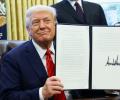
The Trump trade shock is a chance to push long-overdue reforms, rather than tinker with tariffs to appease the US, suggests M Govinda Rao.

The Union Budget for 2026-27, presented by Finance Minister (FM) Nirmala Sitharaman on Sunday, which was a first, had an excellent domestic macro backdrop. According to the first advance estimates, gross domestic product (GDP) in constant prices is projected to grow 7.4 per cent in the current financial year, against 6.5 per cent in 2024-25.

India will now face a lower reciprocal tariff of 10 per cent, down from 25 per cent, after US President Donald Trump announced a new global levy on items imported into America in the wake of the Supreme Court verdict against his sweeping duties on several nations.
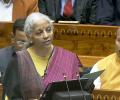
Budget 2026 sticks to fiscal discipline, shuns populist measures despite five key state elections coming up, but ends up rattling stock markets with a higher transaction tax on derivatives trading.

A strong third-quarter (October-December/Q3) performance for 2025-26 (FY26) has helped the stock of India's largest listed pharmaceutical (pharma) company, Sun Pharmaceutical Industries, gain about 7 per cent since the start of February.

Any reduction on purifiers would need consensus among state finance ministers.

Budget 2026 is an intentional and ambitious one - From manufacturing growth to services supremacy, from technology consumption to AI-powered transformation. This is the blueprint for a $7 trillion economy built on intelligence, not just scale.

The Indian Rice Exporter's Federation (IREF) on Tuesday urged the government to provide tax incentives, interest subvention and freight support in the upcoming 2026 Budget to strengthen the sector's competitiveness while addressing sustainability concerns.

India on Thursday signed a free trade agreement, officially dubbed as the Comprehensive Economic and Trade Agreement (CETA), with the UK - its 16th trade pact so far - as the country aims to boost bilateral trade and investments.

Customs regimes can lead to labyrinthine legal disputes. Budget 2026 must recognise that an excessively defensive Customs posture can itself become a trade barrier, point out Mukesh Butani and Shankey Agrawal.

India is growing fast, but to keep growing strong, the government must make more things at home, create jobs, and spend money wisely, suggests Rajiv Memani, regional managing partner, Africa-India Region, EY.

West Asia conflict triggers sharp sell-off in Indian markets, with realty, banking and auto stocks leading losses amid energy shock fears.

The country's primary capital markets delivered a robust performance in FY26, emerging as a global leader in initial public offerings (IPOs) despite an uncertain environment, the Economic Survey said on Thursday.

India has managed high government debt-to-GDP, a slowing domestic revenue engine, lower household savings and a more hostile geopolitical environment separately in the past. But together, they threaten to undo the growth narrative on which today's optimism rests, warns Debashis Basu.

The Indian economy is growing at a robust pace, driven by strong domestic demand, low inflation, and the healthy balance sheets of banks, said a Reserve Bank report released on Wednesday.

Two-wheeler (2W) major Bajaj Auto on Friday posted its highest ever quarterly revenue and profit during the third quarter of 2025-26 (Q3FY26). Bajaj Auto's consolidated net profit for the quarter grew by 25 per cent year-on-year (Y-o-Y) to Rs 2,749 crore, with the revenue also growing 23 per cent to Rs 16,204 crore.

India's economy experienced a growth of 7.8 per cent during the October-December quarter of 2025-26, according to the new series of national accounts with 2022-23 as the base year.

India finalised a free trade agreement with the UK, its 16th so far as the country aimed at boosting bilateral trade and investments. The other regions and countries with which India has signed such agreements include the four-nation European bloc EFTA, Japan, Korea and Australia.
'This Budget has a one-year agenda, which you can call the sprint, and the marathon is towards Viksit Bharat.'

The Budget reflects a clear focus on strengthening India's long-term prospects by leaning on nation-building sectors such as infrastructure, manufacturing, and technology while maintaining fiscal responsibility.

A 500 per cent tariff would effectively shut out India's goods and services exports to the US.

Real GDP growth surprised on the upside in 2025, but weaker nominal growth, trade uncertainty, and soft demand signal a bumpier road ahead.

The Indian economy is likely to grow at 7.4 per cent in 2025-26, up from 6.5 per cent in the previous fiscal, mainly on account of better performance of manufacturing and services sectors, as per the government data released on Wednesday.

The GST Council at its next meeting may consider a reduction in taxes on air and water purifiers as air quality across the country worsens and access to safe drinking water remains uneven.

Ask rediffGURU and tax expert Mihir Tanna your income tax-related questions.

The fiscal tilt towards capex benefits companies in investment-related sectors like capital goods, defence equipment, engineering & construction and metal & mining. The planned cut in revenue expenditure will weigh on companies in consumption sectors like FMCG, consumer durables and retail.
India, the world's fourth largest economy, is set to maintain the 'goldilocks' phase with tailwinds of good growth, low inflation and robust banking performance as well as reform initiatives poised to sustain the economic pace witnessed during 2025.

Restoring weighted tax deductions and adopting a petty patents regime can foster firm-level innovative activity critical for competitiveness, points out Nagesh Kumar.

Homegrown FMCG player Emami Ltd on Monday reported a 29.7 per cent decline in consolidated profit after tax at Rs 148.35 crore in the second quarter ended September 30, 2025, impacted by temporary trade disruption in expectation of GST rate cut and excessive rains affecting certain product categories.

The key question is how much of the latest growth record represents recovery from the 2020-2021 downturn, and what is the sustainable growth rate now, asks T N Ninan.

New Delhi will substantially reduce tariffs on industrial and agricultural goods while continuing to protect sensitive sectors. Tariffs on some agricultural products that are not traditionally considered sensitive will be brought down to zero, while in the case of relatively sensitive items, duties will be reduced in a graded manner and quotas will be imposed.

'The trade deficit in some sectors is huge and that is an area of opportunity to localise.'

Dabur's business update for Q3FY26 indicated mid-single digit consolidated revenue growth. The guidance is that growth in operating and net profits will beat revenue growth. In the domestic business, home and personal care (HPC) revenue grew in double digits, while healthcare is likely to post a sequential growth in low-single digits.

Driven by GST reforms, robust festive demand, and softening raw material prices, the FMCG industry expects volume-based growth, supported by a mid-single digit revenue rise and improved operating margins in the December quarter.
India's real gross domestic product (GDP) is likely to grow at 7.5 per cent in FY26 and moderate to 7 per cent in the subsequent fiscal year, a domestic rating agency said on Wednesday.

The reduction in the goods and services tax (GST) rates has increased the momentum in India's economic activity both on the supply and demand sides, while robust agricultural activity - reflected in the strong onset of rabi sowing and adequate reservoir levels - has reinforced the outlook for food supply and rural incomes, the finance ministry said on Thursday.

'The next two to three weeks will not be decided in Washington.' 'They will be decided in Tehran, in whatever calculation Iran makes about the costs of continued resistance against the costs of appearing to have yielded.'

'We believe the truth is in the middle, and that India is at an important crossroads.'
